India is No. 1 in Global Exports of Gems,
Nos. 2 in Petro Products and Sugar, and No. 3 in Pesticides
[ABS News
Service/03.12.2024]
India's
journey toward becoming a global economic powerhouse is marked by remarkable achievements
in its export landscape. The nation has demonstrated significant progress in
diverse sectors, ranging from petroleum oils and agrochemicals to
semiconductors and precious stones. This growth reflects India's ability to
leverage advanced technology, innovative practices, and competitive
manufacturing to meet global demands. Supported by robust government
initiatives, the country is not only expanding its export base but also
strengthening its position as a reliable global supplier. India's export
performance in several key product categories at the 4-digit HS level has shown
notable success, with the country maintaining or improving its rank among the
top 10 global suppliers, all with export values exceeding $1 billion in 2023.
Below is a detailed
exploration of India's robust performance in various key export categories,
highlighting its advancements in global trade:
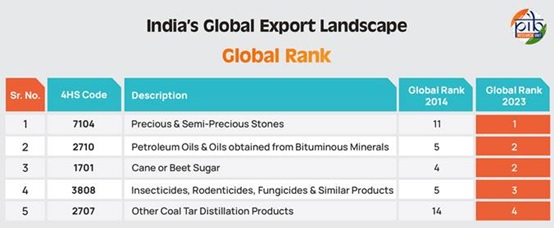
India has
emerged as a dominant player in the global export market, showcasing remarkable
growth across various sectors. The petroleum sector (Petroleum Oils and Oils
Obtained from Bituminous Minerals) has seen a dramatic rise, with export
values increasing from $60.84 billion in 2014 to $84.96 billion in 2023,
capturing a global market share of 12.59%. This significant leap has propelled
India to the position of the second-largest global exporter, driven by advanced
refining infrastructure, increased production capacity, and adherence to
international standards, solidifying its reputation as a dependable energy
supplier worldwide.
In the
agrochemical sector, India has achieved notable success, particularly in
insecticides, rodenticides, and fungicides. By 2023, exports reached $4.32
billion, marking a global market share of 10.85%, up from 5.89% in 2014.
Investments in research and development, coupled with compliance with
international agricultural standards, have positioned India as the
third-largest exporter globally. This growth underscores India’s pivotal role
in supporting sustainable agriculture.
India’s sugar exports have also witnessed exceptional growth, with the
country’s share in the global market for cane or beet sugar rising from 4.31%
in 2014 to 12.21% in 2023. Export values reached $3.72 billion in 2023,
cementing India’s position as the second-largest sugar exporter. Strong
production bases and favourable agricultural policies have enabled India to
cater to growing demand, particularly in Southeast Asia and Africa,
strengthening its agricultural economy.

The
electronics manufacturing sector has shown significant advancements, reflected
in the exports of electrical transformers and related components, which grew
from $1.08 billion in 2014 to $2.85 billion in 2023. India’s global market
share increased to 2.11% in 2023, and it is in 10th position,
up from 17th in 2014. Government initiatives such as "Make in India"
and production-linked incentive schemes have bolstered this progress, creating
a robust manufacturing ecosystem.
India has made
remarkable strides in rubber pneumatic tyre exports, which reached $2.66
billion in 2023. Its global market share rose to 3.31%, securing the 8th
position, a notable leap from 14th in 2014. This growth reflects India’s
emphasis on quality, cost competitiveness, and the ability to serve diverse
markets, particularly in emerging economies. Similarly, exports of taps,
valves, and similar industrial products reached $2.12 billion in 2023,
capturing a 2.16% global market share and earning India the 10th position
globally. Advanced manufacturing processes and adherence to international
standards have contributed to this success.

The country’s
strategic focus on electronics and semiconductors has yielded impressive
results. Exports grew from $0.23 billion in 2014 to $1.91 billion in 2023,
achieving a global market share of 1.40% and securing the 9th position, a
significant jump from 20th in 2014. This progress highlights India’s growing
role in the global semiconductor supply chain, supported by efforts to enhance
domestic manufacturing and innovation. Additionally, India’s exports of coal
tar distillation products reached $1.71 billion in 2023, capturing a 5.48%
global market share and securing 4th place globally showcasing its importance
in industrial value chains.
In the export
of precious and semi-precious stones, India has established itself as the world
leader, with its global share surging from 2.64% in 2014 to an astounding
36.53% in 2023. Exports valued at $1.52 billion highlight India’s centuries-old
craftsmanship and adoption of modern technology in gemstone processing. Exports
of parts for electric motors and generators have also shown significant growth,
reaching $1.15 billion in 2023, with a global share of 4.86%, elevating India
to 6th place from 21 in 2014 globally. This growth aligns with the rising
global demand for renewable energy and electric vehicle components, positioning
India as a key supplier in this transformative industry.
Government Initiatives to Strengthen India’s Export Landscape
The Central
Government has implemented various initiatives and policies to enhance exports,
attract investments, and promote ease of doing business. A New Foreign
Trade Policy was launched on March 31, 2023, and took effect on April
1, 2023. The policy's core approach is built on four key pillars: (i) Incentives for Remission, (ii) Export promotion through
collaboration with exporters, states, districts, and Indian missions, (iii)
Enhancing ease of doing business by reducing transaction costs and implementing
e-initiatives, and (iv) Focus on emerging areas such as e-commerce, developing
districts as export hubs, and streamlining the SCOMET (Special Chemicals
Organisms Materials Equipment and Technologies) policy. It emphasizes emerging
sectors like dual-use high-end technology under SCOMET, boosting e-commerce
exports, and fostering collaboration between states and districts for export
growth. The new Foreign Trade Policy (FTP) introduces a one-time Amnesty Scheme
to help exporters clear old pending authorizations and start anew. It also
promotes the recognition of new towns through the "Towns of Export
Excellence Scheme" and acknowledges exporters via the "Status Holder
Scheme."
To further
support exporters, the Interest Equalization Scheme on pre- and
post-shipment rupee export credit has been extended until August 31, 2024, with
an allocation of Rs. 12,788 crores. Assistance is also being provided through
schemes like the Trade Infrastructure for Export Scheme (TIES) and the Market
Access Initiative (MAI).
To promote
labour-intensive sector exports, the Rebate of State and Central Levies
and Taxes (RoSCTL) Scheme has been in place
since March 7, 2019, while the Remission of Duties and Taxes on
Exported Products (RoDTEP) Scheme has been
implemented since January 1, 2021. The RoDTEP Scheme
was further expanded on December 15, 2022, to cover previously excluded sectors
like pharmaceuticals, organic and inorganic chemicals, and iron and steel
products. Additionally, anomalies in 432 tariff lines were addressed with
revised rates effective from January 16, 2023. A Common Digital
Platform for the Certificate of Origin has been launched to boost Free
Trade Agreement (FTA) utilization by exporters.
The Districts
as Export Hubs initiative identifies export-potential products in each
district and addresses bottlenecks while supporting local exporters and
manufacturers to generate employment. Indian missions abroad play an enhanced
role in promoting India’s trade, tourism, technology, and investment goals.
There is regular monitoring of performance involving with Commercial Missions
abroad, Export Promotion Councils, Commodity Boards/ Authorities and Industry
Associations, with corrective measures implemented as needed.
To attract
domestic and foreign investments, the Government has introduced reforms such as
the Goods and Services Tax (GST), corporate tax reduction, FDI policy changes,
measures to reduce compliance burdens, and initiatives to boost domestic
manufacturing through public procurement orders, the Phased Manufacturing
Programme (PMP), and Quality Control Orders (QCOs). The Production-Linked
Incentive (PLI) Schemes for 14 key sectors, with an outlay of Rs. 1.97 lakh
crore, aim to enhance manufacturing capabilities and exports.
The Government
has prioritized simplifying, rationalizing, digitizing, and decriminalizing its
interface with businesses and citizens across all States and UTs. Over 42,000
compliances have been reduced, and more than 3,800 provisions have been
decriminalized. The National Single Window System (NSWS) allows
businesses to apply for 277 Central approvals, with information on 661
approvals available through the Know Your Approvals (KYA) module. The Jan
Vishwas (Amendment of Provisions) Act, 2023, promotes trust-based
governance, decriminalizing 183 provisions under 42 Acts managed by 19
ministries and departments.
India’s
roadmap for 2047 emphasizes global competitiveness, innovation, and integration
into global supply chains. Policy reforms have improved India’s rank in
the World Bank’s Doing Business Report from 142nd in 2014 to 63rd in
2019. Also, India’s rank in the Global Innovation Index (GII)
amongst 132 economies has improved from 81st in 2015 to 40th in 2023.
Intellectual Property Right (IPR) reforms have boosted patent grants from 5,978
in 2014-15 to 103,057 in 2023-24, while the number of designs registered grew
from 7,147 to 30,672 during the same period.
The Startup India initiative, launched to foster
innovation and entrepreneurship, has created a strong ecosystem, with 1.33 lakh
DPIIT-recognized startups. Its action plan spans
simplification, funding support, and industry-academia partnerships. Trade
policy reforms have furthered India’s participation in global supply chains.
The Foreign Trade Policy focuses on cost competitiveness,
trade facilitation, and emerging sectors, provides a strong framework for
promoting global supply chain participation.
On October
13th, 2021, the Government of India launched the PM GatiShakti
National Master Plan to support infrastructure and social sector
planning through the PM GatiShakti NMP GIS-enabled
portal. The implementation of PMGS promotes multimodal connectivity, improves
last-mile connectivity, and contributes to both Ease of Doing Business and Ease
of Living. To complement the PM GatiShakti NMP,
the National Logistics Policy (NLP) was introduced on
September 17th, 2022 with the goal of reducing logistics costs and enhancing
logistics efficiency across the country. Together, these policies are driving
innovation and enabling greater integration with global supply chains.
The
comprehensive Trade Connect e-Platform launch has successfully linked more than
6 lakh IEC holders, 185 Indian Mission officials, and over 600 Export Promotion
Council members with the Directorate General of Foreign Trade (DGFT)/DoC offices and banks. This digital initiative improves the
ease of doing business for small and medium enterprises (SMEs) by offering them
valuable information and support, creating a more efficient and transparent
export ecosystem. The government has rolled out Enhanced Insurance Cover for
MSME Exporters to promote exports, which is expected to provide Rs. 20,000
crore in credit at reduced costs. This initiative aims to enhance the
competitiveness of Indian exports and will benefit approximately 10,000
exporters.
The
self-certified electronic Bank Realization Certificate (eBRC)
system reduces compliance costs, saving exporters over ₹125 crore. This system
also supports the government's broader objectives of fostering a digital,
eco-friendly economy, reducing both administrative and environmental costs. The
bulk generation and Application Programming Interface (API) integration of eBRCs streamline the process for exporters, especially
small e-commerce businesses, by efficiently managing high-volume, low-cost
transactions. This system helps them claim benefits and refunds more
effectively, supporting their growth in international trade.
The E-Commerce
Export Hub (ECEH) initiative aims to revolutionize India’s
cross-border e-commerce, potentially reaching USD 100 billion in exports by
2030. These hubs connect SMEs, artisans, and One District One Product (ODOP)
producers to global markets, boosting logistics efficiency and economic
inclusion in Tier 2 and Tier 3 cities. On the Government e-Marketplace
(GeM), revised pricing slabs now cap charges at
₹3 lakh for orders above Rs. 10 crore, significantly reducing transaction
costs. The Bharat Mart in Dubai provides Indian MSMEs
affordable access to Gulf Cooperation Council (GCC), African, and CIS markets,
enhancing exports to these regions.
Jansunwai, a platform that facilitates direct communication
between stakeholders and the Government, eliminating intermediaries and saving
time. A revamped National Programme of Organic Production (NPOP) is set
to benefit approximately 20 lakh farmers from 5,000 grower groups through
enhanced export opportunities. It is expected to drive organic exports beyond
USD 1 billion by 2025-26, benefiting approximately 20 lakh farmers.
ICEGATE
(Indian Customs Electronic Commerce/Electronic Data Interchange Gateway) offers
e-filing services to trade, cargo carriers, and other trading partners.
Additionally, it provides facilities like e-payment, online registration for
IPR, document tracking status at Customs EDI, online verification of
DEPB/DES/EPCG licenses, IE code status, PAN-based CHA data, and links to
various other key Customs-related websites and information. The platform also
features a 24/7 helpdesk for trading partners.
These
initiatives underline the Government’s dedication to expanding India’s trade
and fostering inclusive development, positioning India as a global economic
powerhouse by 2047.
Conclusion
India’s export
achievements are a testament to its evolving manufacturing capabilities,
strategic policies, and commitment to innovation. From dominating the global
market in precious stones to making inroads in advanced sectors like
semiconductors and electrical components, India’s export journey underscores
its growing economic prowess. The government's forward-looking initiatives,
such as the New Foreign Trade Policy, PLI Schemes, and many others, play a
pivotal role in enhancing India’s competitiveness on the global stage. As India
diversifies its export portfolio and strengthens its global presence, it is
poised to achieve its vision of becoming a global economic power by 2047.