India Shrugs Off US Move to End Preferential Trade Treatment
Impact
limited to $190 m a year, says Commerce Secretary; will continue talks to iron
out differences
The duty-free status available to 3,500 Indian goods exported
to the US market will end soon as the Trump administration has decided to
withdraw the benefits extended to the country under the Generalised
System of Preferences (GSP). The concession has been rolled back on the grounds that India is not providing equitable market
access to American businesses. The US is also terminating Turkey’s designation
as a beneficiary of the scheme.
The withdrawal of the scheme will not have a significant
impact on exports to America, as the benefits to exporters added up to just
about $190 million annually, said Commerce Secretary Anup
Wadhawan. Of the about 3,500 products it covers,
India made use of the concession for just 1,784. Delhi will,
however, continue its talks with Washington to sort out mutual concerns,
he added. Wadhawan said the US has decided to impose
the duties despite the fact that India is working on an extensive and
reasonable trade package.
“At the direction of President Donald Trump, US Trade
Representative (USTR) Robert Lighthizer announced
today that the US intends to terminate India’s and Turkey’s designations as
beneficiary developing countries because they no longer comply with the
statutory eligibility criteria,” said an official USTR release.
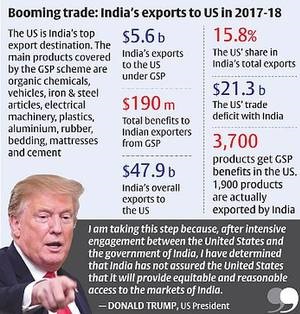 The GSP scheme, launched in 1974, aims to assist
developing countries in increasing their exports. India has been the biggest
beneficiary of the scheme, with exports worth $5.6 billion being
covered annually.
The GSP scheme, launched in 1974, aims to assist
developing countries in increasing their exports. India has been the biggest
beneficiary of the scheme, with exports worth $5.6 billion being
covered annually.
The withdrawal follows a review initiated last year by
the USTR against India on the basis of complaints of
market access problems from the US dairy and medical equipment industry. US
trade officials said scrapping the concessions will
take at least 60 days after notifications to the US Congress and the Indian
government.
Wadhawan said the Commerce Ministry worked with several
departments to try to sort out the problem, but it did not work. “We were
successful in formulating a reasonable package which addressed most concerns of
the US. However, there were additional requests which could not be
accommodated,” he said.
Trump troubles
India’s recent spate of trouble started soon after Trump
came to power. The Trump administration listed India among the countries with
which the US runs a trade deficit, and asked the US Commerce Department to
“identify every form of trade abuse and every non-reciprocal practice that
contributes to the US trade deficit.”
Washington has not recognised
New Delhi’s efforts to trim the trade deficit. The trade deficit narrowed by
almost 6 per cent in 2017 to $22.9 billion, according to the USTR. With India
buying oil and gas from the US for the first time in 2018 for an estimated $3
billion, the gap is expected to shrink by about $4
billion.
Last year, India was one of the countries on which the US
imposed penal import duties on aluminium and steel,
citing security threats. New Delhi announced its decision to
impose retaliatory duties on 29 American products but has been postponing the
intended implementation date. The new date is April 1, 2019, but the
government has not decided yet on what it plans to do.
The US was India’s top export destination in 2017-18 with
shipments worth $47.88 billion. India’s imports from the country were worth
$26.61 billion.
What is GSP?
The Generalised System of
Preferences, or GSP, is a tariff scheme that facilitates duty-free entry for
thousands of products from designated beneficiary countries