It’s Time to Tax
the Billionaires
·
Netherlands,
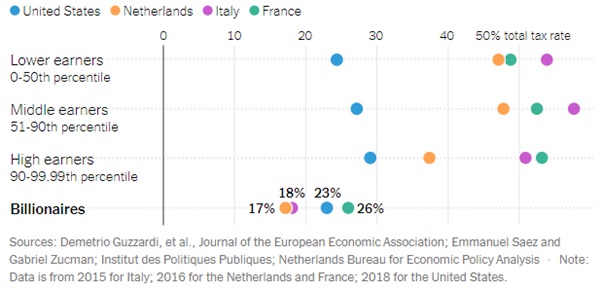
for instance, the average taxpayer in 2016 gave 45 percent of earnings to the
government, while billionaires paid just 17 percent.
·
While
most of us live off our salaries, tycoons like Jeff Bezos live off their
wealth.
·
Mr. Musk,
for example, used his shares in Tesla as collateral to rustle up around $13
billion in Tax-free loans to put toward his acquisition of Twitter.
·
In
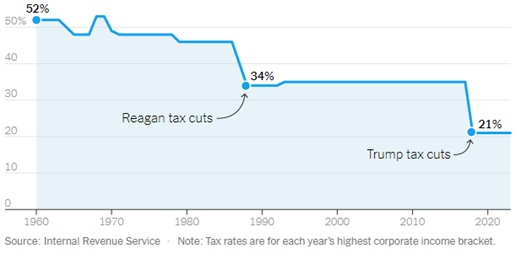
2018, the United States cut its maximum corporate tax rate to 21 percent from
35 percent. And the estate tax has almost disappeared in America.
·
One
obstacle to taxing the very rich is the risk they may move to low-tax
countries.
· Billionaires who built their fortune in France, Sweden or Germany have established residency in Switzerland
[ABS News
Service/06.05.2024]
Until
recently, it was hard to know just how good the superrich are at avoiding
taxes. Public statistics are oddly quiet about their contributions to
government coffers, a topic of legitimate interest in democratic societies.
Over the
past few years, I and other scholars have published studies and books
attempting to fix that problem. While we still have data for only a handful of
countries, we’ve found that the ultrawealthy consistently avoid paying their
fair share in taxes. In the Netherlands, for instance, the average taxpayer in
2016 gave 45 percent of earnings to the government, while billionaires paid
just 17 percent.
Billionaires avoid taxes outside
the United States, too
Why do the
world’s most fortunate people pay among the least in taxes, relative to the
amount of money they make?
The simple
answer is that while most of us live off our salaries, tycoons like Jeff Bezos
live off their wealth. In 2019, when Mr. Bezos was still Amazon’s chief
executive, he took home an annual salary of just $81,840. But he owns roughly
10 percent of the company, which made a profit of $30 billion in 2023.
If Amazon gave
its profits back to shareholders as dividends, which are subject to income tax,
Mr. Bezos would face a hefty tax bill. But Amazon does not pay dividends to its
shareholders. Neither does Berkshire Hathaway or Tesla. Instead, the companies
keep their profits and reinvest them, making their shareholders even wealthier.
Unless Mr.
Bezos, Warren Buffett or Elon Musk sell their stock, their taxable income is
relatively minuscule. But they can still make eye-popping purchases by
borrowing against their assets. Mr. Musk, for example, used his shares in Tesla
as collateral to rustle up around $13 billion in tax-free loans to put toward
his acquisition of Twitter.
Outside
the United States, avoiding taxation can be even easier.
Take
Bernard Arnault, the wealthiest person in the world.
Mr. Arnault’s shares in LVMH, the luxury goods
conglomerate, officially belong to holding companies that he controls. In 2023,
Mr. Arnault’s holdings received about $3 billion in
dividends from LVMH. France — like other European countries — barely taxes
these dividends, because on paper they are received by companies. Yet Mr. Arnault can spend the money almost as if it were deposited
directly into his bank account, so long as he works through other incorporated
entities — on philanthropy, for instance, or to keep his megayacht
afloat or to buy more companies.
Historically,
the rich had to pay hefty taxes on corporate profits, the main source of their
income. And the wealth they passed on to their heirs was subject to the estate
tax. But both taxes have been gutted in recent decades. In 2018, the United
States cut its maximum corporate tax rate to 21 percent from 35 percent. And
the estate tax has almost disappeared in America. Relative to the wealth of
U.S. households, it generates only a quarter of the tax revenues it raised in
the 1970s.
The falling U.S. corporate tax rate
So what
should be done?
One
obstacle to taxing the very rich is the risk they may move to low-tax
countries. In Europe, some billionaires who built their fortune in France,
Sweden or Germany have established residency in Switzerland, where they pay a
fraction of what they would owe in their home country. Although few of the
ultrawealthy actually move their homes, the possibility that they might has
been a boogeyman for would-be tax reformers.
There is a
way to make tax dodging less attractive: a global minimum tax. In 2021, more
than 130 countries agreed to apply a minimum tax rate of 15 percent on the
profits of large multinational companies. So no matter where a company parks
its profits, it still has to pay at least a baseline amount of tax under the
agreement.
In
February, I was invited to a meeting of Group of 20 finance ministers to
present a proposal for another coordinated minimum tax — this one not on corporations,
but on billionaires. The idea is simple. Let’s agree that billionaires should
pay income taxes equivalent to a small portion — say, 2 percent — of their
wealth each year. Someone like Bernard Arnault, who
is worth about $210 billion, would have to pay an additional tax equal to
roughly $4.2 billion if he pays no income tax. In total, the proposal would
allow countries to collect an estimated $250 billion in additional tax revenue
per year, which is even more than what the global minimum tax on corporations
is expected to add.
Critics
might say that this is a wealth tax, the constitutionality of which is debated
in the United States. In reality, the proposal stays firmly in the realm of
income taxation. Billionaires who already pay the baseline amount of income tax
would have no extra tax to pay. The goal is that only those who dial down their
income to dodge the income tax would be affected.
Critics
also claim that a minimum tax would be too hard to apply because wealth is
difficult to value. This fear is overblown. According to my research, about 60
percent of U.S. billionaires’ wealth is in stocks of publicly traded companies.
The rest is mostly ownership stakes in private businesses, which can be
assigned a monetary value by looking at how the market values similar firms.
One
challenge to making a minimum tax work is ensuring broad participation. In the
multinational minimum tax agreement, participating countries are allowed to
overtax companies from nations that haven’t signed on. This incentivizes every
country to join the agreement. The same mechanism should be used for
billionaires. For example, if Switzerland refuses to tax the superrich who live
there, other countries could tax them on its behalf.
We are
already seeing some movement on the issue. Countries such as Brazil, which is
chairing the Group of 20 summit this year and has shown extraordinary
leadership on the issue, and France, Germany, South Africa and Spain have
recently expressed support for a minimum tax on billionaires. In the United
States, President Biden has proposed a billionaire tax that shares the same
objectives.
To be
clear, this proposal wouldn’t increase taxes for doctors, lawyers,
small-business owners or the rest of the world’s upper middle class. I’m
talking about asking a very small number of stratospherically wealthy
individuals — about 3,000 people — to give a relatively tiny bit of their
profits back to the governments that fund their employees’ educations and
health care and allow their businesses to operate and thrive.
The idea
that billionaires should pay a minimum amount of income tax is not a radical
idea. What is radical is continuing to allow the wealthiest people in the world
to pay a smaller percentage in income tax than nearly everybody else. In
liberal democracies, a wave of political sentiment is building, focused on
rooting out the inequality that corrodes societies. A coordinated minimum tax
on the superrich will not fix capitalism. But it is a necessary first step.