ICRIER says India 3rd
Most Digitised Country in the World in 16 point New Frame, US and China are 1st
and 2nd
·
Govt
Restrictions on Service Providers and Users not in the Frame!
·
State
of India’s Digital Economy (SIDE) 2024 presents a new approach to measure
digitalisation.
·
Proposing
two separate indices – CHIPS (Economy) and CHIPS (User).
Executive Summary
A new way to measure digitalisation: The
CHIPS framework
Digitalisation has made dramatic
progress, but the way it is being measured has not. Three of the most widely cited global
indices on digitalisation were conceived nearly two decades ago – the
E-Government Development Index (EGDI), produced by the United Nations, first
published in 2001, the Network Readiness Index (NRI), conceived at Harvard
University, launched in 2002, and the International Telecommunication Union’s
ICT Development Index (IDI), first released in 2009. At the time of their
conceptualisation, digitalisation was largely defined by access; more specifically,
access to the internet through fixed broadband. Developing countries – both
because of their limited resources and the conviction that they could leapfrog
through various stages of digital transformation – have travelled a different
path towards digitalisation than that by their developed country counterparts.
Despite having evolved, existing global indices put “connectivity of the
individual user” at the centre, presenting an incomplete picture of
digitalisation in developing countries, including that of India.
The State of India’s Digital Economy
(SIDE) 2024 presents a new approach to measure digitalisation. This approach is better suited for
developing countries like India for three reasons. First, it proposes a much
wider definition of digitalisation through its
Connect-Harness-Innovate-Protect-Sustain (CHIPS) framework, capturing both the
opportunities and risks created by digitalisation. Second, unlike global
indices that focus entirely on the average user, SIDE 2024 recognises the scale
of the network and depth of use of technology at the economy-wide level by
proposing two separate indices – CHIPS (Economy) and CHIPS (User). Finally,
while most global indices focus on both outcomes and inputs (enablers) of digitalisation
– thus penalising developing countries twice, once for a low score on outcome
and then again for a low score on inputs – CHIPS is almost entirely estimated
using outcome indicators.
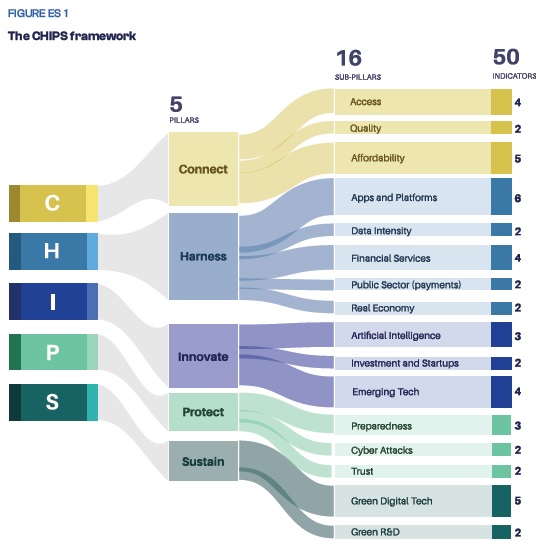
The CHIPS framework has three tiers:
pillars, sub-pillars and indicators. The
five pillars – Connect, Harness, Innovate, Protect and Sustain – measure the
entire spectrum of digital transformation (see Figure ES1). The five pillars
are classified into 16 sub-pillars, that are further categorised into 50
indicators. Many indicators in our framework overlap with the global indices,
though we also introduce several new ones (see Annexure 1 and 2 for more
details). We also extend the CHIPS framework to the sub-national level,
enabling comparison of the level of digitalisation across 28 Indian states and
8 union territories (UTs).
India is the third largest digitalised
country in the world
When compared by their aggregate level of
digitalisation, India ranks as the third largest digitalised country in the
world, behind the US and China, and ahead of the UK, Germany and
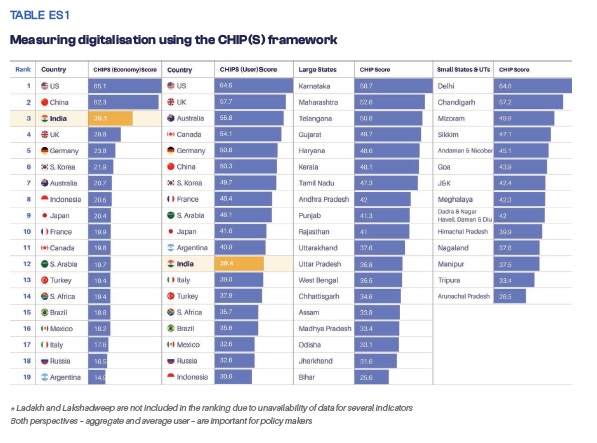
Japan (see Table ES1). While the US ranks first with a score of 65 and China a
close second with 62, India is a distant third with a score of 39, followed by
the UK (29), Germany (24) and South Korea (22). India’s third rank is driven by
two scale-driven pillars, Connect and Harness, that collectively contribute 66
per cent to India’s total score. At the sub-pillar level, India seems to be
operating at the global frontier in six sub-pillars (cyber
attacks, affordability, access, public sector (payments), real economy
and trust), at a moderate distance from the global frontier in seven
sub-pillars (apps and platforms, AI, green digital tech, data intensity,
quality, investments and start-ups and financial services), and far away from
the frontier in three sub-pillars (emerging technology, preparedness and green
R&D).
FIGURE ES 1
The CHIPS framework
Source: Source: IPCIDE Research
Highly digitalised nation, moderately
digitalised users
While India as a nation is vastly
digitalised, the average user is not. This explains why India is
ranked 12th among the G20 countries in terms of level of digitalisation of the
user, i.e., by CHIPS (User), as shown in Table ES 1. This is not entirely
unexpected, as India is the poorest country in the G20, and consumption of
digital goods and services exhibit strong positive correlation with per capita income.
But even by this criterion, India’s score is higher than all G20 developing
countries except China and Argentina, and is ranked above Italy, a G7 country.
From the perspective of the experience of the average user, India is placed at
the very bottom in the Connect and Harness pillars. Additionally, India’s
gender gap in internet connectivity at 10 per cent, is higher than the world
average of 9 per cent. The rural-urban divide is even higher at 58 per cent,
vis-à-vis the world average at 49 per cent. However, India continues to score
high on the Innovate pillar, and accounts for nearly one-third of India’s CHIPs
(User) score. And within Innovate, the two biggest contributing sub-pillars are
AI and start-ups. The fact that India is doing well in the production of newer
technologies (such as AI) but lags behind in the adoption of older basic
technologies (such as broadband and internet) is a reflection of its own
intrinsic duality: the second highest IT services exporter in the world with
the largest unconnected population.
Richer states are more digitalised than the
poorer ones, but the dispersion within India is lower than between G20
countries
Richer states and union territories (UTs) in
India have relatively higher levels of digitalisation than poorer states, but
the gap is shrinking. The top 5 states according to
CHIP score – Karnataka, Maharashtra, Telangana, Gujarat and Haryana – are also
amongst the richer states in India. For UTs and smaller states (population less
than 1 crore) as well, Delhi, Chandigarh are the top ranked UTs and also have
the highest per capita income among UTs (see Table ES 1). No single state
dominates the ranking table across the 14 different sub-pillars. For example,
top five performer positions at the sub-pillar level are shared by nine
different states. Interestingly, dispersion in the level of digitalisation when
measured through the CHIP framework is found to be less unequal at the sub-national
level than across G20 countries. The CHIP score for larger states in India have
a smaller range (difference between the maximum and minimum value) compared to
CHIP (User).
Both perspectives – aggregate and average user
– are important for policymakers
The state of India’s digital economy
should include both the aggregate level as well the average user analysis. CHIPS
(Economy) reflects the enormous scaling up that India
has been able to achieve in connecting millions to the internet and enabling
use of digital services at population scale. CHIPS (User) highlights India’s
record performance in AI and the start-up economy despite gaps in connectivity
and persistent digital divides. Both perspectives are important for policymakers.
The success of the DPI approach as a policy choice in providing scale should be
celebrated, while the lack of basic infrastructure, challenges of affordability,
and limited progress on greening its digital infrastructure should be
scrutinised. An approach that combines the lens of CHIPS (Economy) and CHIPS
(User), therefore, is an effective tool to measure digitalisation, especially
for developing countries that do not walk the beaten path of developed
countries.